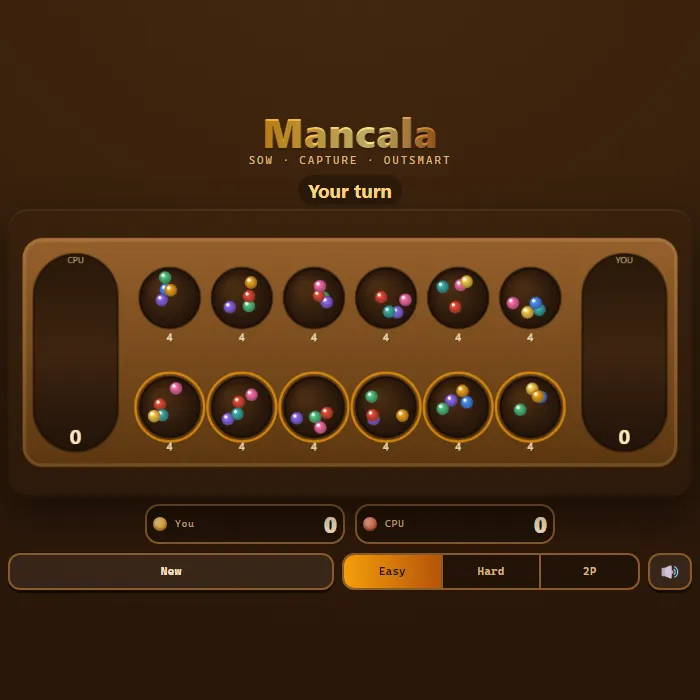
Sow and capture stones on the classic Kalah board against a minimax AI or a friend on the same device. Extra turns, captures, nothing to install.
About Mancala
Mancala is one of the oldest games humans still play, and this version keeps the warm, tactile feel of a carved wooden board while sharpening the strategy underneath. Scoop up a pit of stones and sow them one by one around the board; land your final stone squarely in your own store and you go again, which is where the real fun starts. String two or three bonus turns together and you can dismantle an opponent before they touch a stone.
The other sweet moment is the capture: drop your last stone into an empty pit on your own side and you scoop it plus everything sitting in the pit directly across — sometimes a fistful of your rival's stones vanishing into your store in one satisfying sweep. Read the board, count the pits, and set the trap a move early.
Play a friend in local 2-Player, or take on the CPU. Easy is a friendly sparring partner; Hard runs a minimax search that hoards bonus turns and punishes loose pits. Your record against the machine is saved between sessions. Perfect for a quick brain-stretch or a slow, thoughtful duel.
Where Mancala comes from
Mancala is a family of sowing games played across Africa and the Middle East for at least 1,700 years: the earliest undisputed boards, from Gedera in Israel, date to the 2nd-3rd century AD, and the name comes from the Arabic naqala, 'to move'. The two-row version with six pits a side and a store at each end that most people know is Kalah, patented and sold in the United States by William Julius Champion Jr. in 1955, and computers have since solved it as a first-player win with perfect play. This version is 360 PlayZone's own take on the classic. Source.
Inside Mancala: what we checked
The numbers below come from Mancala's own source code, and the screenshots are from our own test run of the game (20 October 2026).
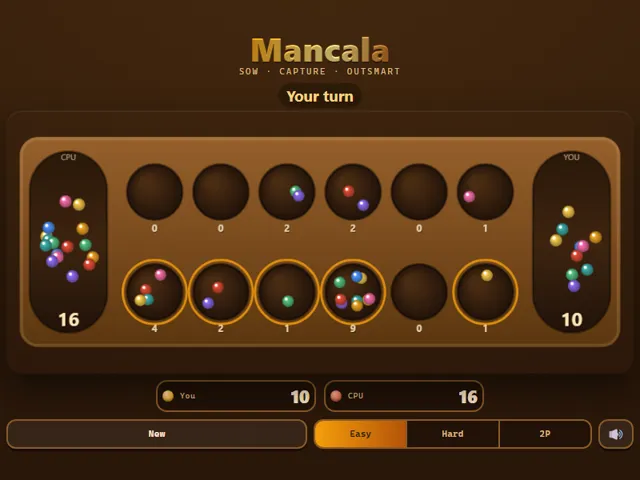
- Each of the 12 pits starts with 4 stones, 48 in all. You always move first against the computer. Stones are dropped one per pit and skip the opponent's store.
- A last stone in your own store gives a bonus turn.
- A capture happens only when your last stone lands in an empty pit on your own side and the pit opposite it holds stones. You then bank both the opposite stones and your landing stone.
- The game ends as soon as either side has no stones. Whatever is still on the other side then goes into that player's own store, not the one who ran out.
- CPU Easy takes a bonus-turn move about 75% of the time when it has one, otherwise grabs the biggest capture about 70% of the time, and otherwise plays a random pit. CPU Hard searches seven moves ahead, and bonus turns do not use up its depth.
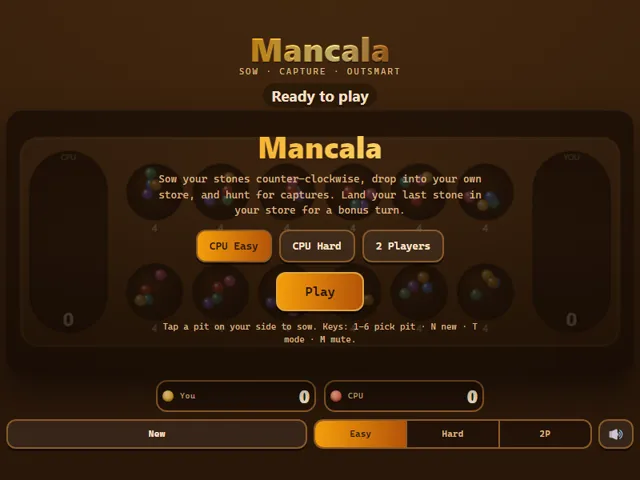
- Keys 1 to 6 play your pits from left to right, T cycles through the three modes and N starts a new game. Your wins, losses and draws against the computer are saved in this browser.
Unblocked Chromebook No Download Mobile Multiplayer
How to play Mancala
On your turn, tap one of your own non-empty pits to scoop its stones and sow them one per pit, moving counter-clockwise and dropping into your own store (but skipping your opponent's). If your last stone lands in your store, take another turn. If it lands in an empty pit on your side, you capture that stone plus every stone in the pit opposite. When one side is empty the game ends, leftover stones go to their owner, and the most stones wins.
Controls
Mouse/touch: tap a pit on your side to sow. Keyboard: 1-6 pick one of your pits, N new game, T cycle mode, M mute.
Tips & tricks
- Landing your last stone in your own store earns a bonus turn — chain several in a row to run the board.
- Set up captures: aim to drop your final stone in an empty pit on your side when the pit across it is loaded.
- Count before you sow. Knowing exactly where your last stone lands is the whole game.
- Guard your rightmost pits (closest to your store) — they feed your bonus turns and are easy to accidentally empty.
Frequently asked questions
Is this Mancala the Kalah or Oware version?
Kalah — the two-store, six-pit layout most people learn first: an extra turn when your last stone lands in your store, and a capture when it lands in an empty pit on your side. Oware uses different capture rules and no stores.
How many stones are in Mancala?
48 — four stones in each of the twelve small pits at the start, and none in the two stores. The game ends when one side of the board is empty.
Does the first player have an advantage in Mancala?
With four stones per pit, Kalah has been solved: the first player wins with perfect play. Against a human that rarely matters; against the Hard AI, going second is the real challenge.
Does Mancala save my progress?
Partly. Mancala keeps a running win/loss tally and your settings in this browser's local storage; there is no level progress to save. Nothing is uploaded and no account is involved — clearing your browser data is what resets it.
Embed Mancala
From our blog
Mancala features in Mancala Online: Kalah Rules, the Extra-Turn Opening and How to Set Up Captures.