Mahjong
Every kind of mahjong in one place — the stacked turtle you match pair by pair, the flat connect boards where the path matters more than the tile, and the triple-tile variants that quietly rewire the whole puzzle. Free, instant, nothing to install.
- Playable
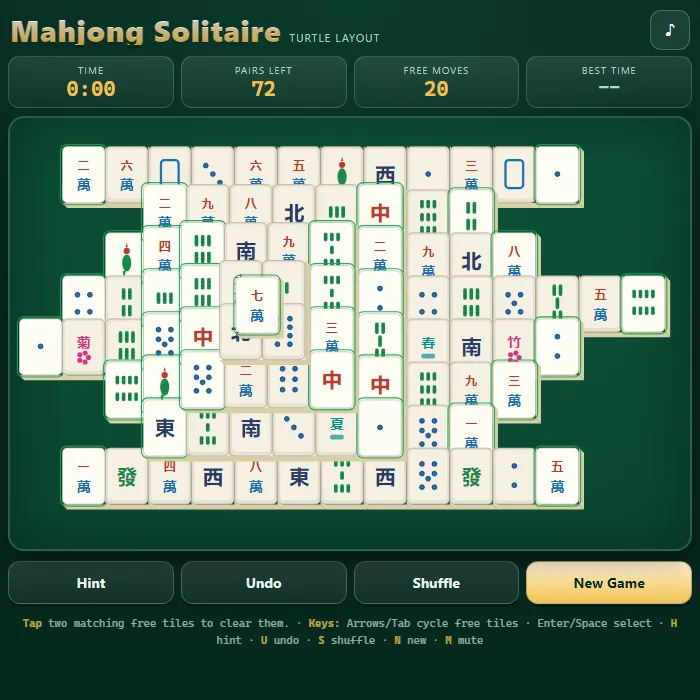 Mahjong Solitaire
 - Playable
 Mahjong Connect
 - Playable
 Mahjong Classic
 - Playable
 Mahjong Match
 - Playable
 Mahjong Master
 - Playable
 Triple Mahjong
 - Playable
 Mahjong Voyage
 - Playable
 Cartoon Mahjong
 - Playable
 Mahjong Cube 3D
 - Playable
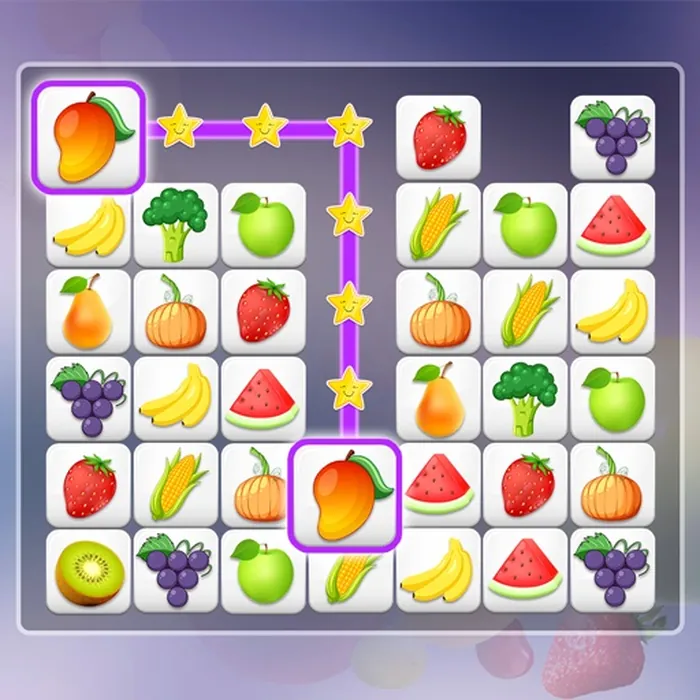 Tile Pair Link
 - Playable
 Arcane Mahjong
 - Playable
 Alphabet Mahjong
Where to start
Mahjong Classic
Connect mahjong — the one most people actually mean. Two tiles clear if you can draw a line between them that bends no more than twice. Easiest to learn, and the variant with the widest following.
Mahjong Match
The stacked turtle. A tile is playable only when nothing rests on top and one long side is open, so the whole game is choosing which pair to spend and which to save for later.
Mahjong Solitaire
Traditional tiles, traditional layouts, no theming in the way. If you already know mahjong and just want a proper board, start here.
Triple Mahjong
Three of a kind instead of two, collected into a tray at the bottom. A small rule change that makes every instinct from ordinary mahjong slightly wrong for a board or two.
Mahjong Master
The difficult one. Denser stacks, a real clock, and boards built so the obvious opening match is usually the wrong one.
Cartoon Mahjong
Animal faces instead of Chinese suits. Nobody misreads an elephant, so the puzzle is pure planning — the friendliest way into mahjong if you have never played.
Which mahjong should you play?
They share tiles and almost nothing else. The three families play so differently that being good at one barely helps with another.
- Turtle solitaire — tiles stacked in layers; only free tiles match. Planning game. Try Mahjong Match or Mahjong Solitaire.
- Connect and link — a flat grid where a pair clears only if a path of two turns or fewer joins them. Geometry game. Try Mahjong Classic or Tile Pair Link.
- Triple matching — collect three identical faces into a limited tray. Inventory game, and the one that ends runs fastest. Try Triple Mahjong.
- Themed sets — the same rules with animal, rune or letter faces, which changes how fast you can read the board. Try Mahjong Safari or Alphabet Mahjong.
The one rule everything else hangs on
In stacked mahjong a tile is free when nothing is resting on top of it and at least one of its long sides is unblocked. That is the whole constraint, and every layout is built to exploit it.
It is why greedy play loses. The board almost always offers more than one legal match, and taking the easy pair in the open instead of the pair holding up a stack is how you end up staring at four identical tiles you cannot reach. Clear downward pressure first, convenience second.
Why connect boards feel completely different
Connect mahjong has no stacking at all, so every tile is technically reachable from the start. The difficulty moves entirely into the path: two twins on opposite edges of a solid block cannot be joined until you have opened a lane, no matter how clearly you can see them.
That flips the strategy. On a turtle you clear from the top down; on a connect board you clear from the outside in, and the clears worth making are the ones that open a long straight corridor across the middle.
Playing on a phone
Every board here is landscape-first and scales to fit the screen, so nothing needs pinching or scrolling. Tiles are large enough to tap accurately, and progress is kept in your browser rather than an account, so closing the tab mid-board is not a disaster.
The themed sets are noticeably kinder on a small screen than the traditional suits — bamboo four and bamboo five differ by a single stroke, which is a genuinely hard read at phone size. If you are playing on a commute, the animal or letter sets will cost you fewer misclicks.
Frequently asked questions
Is this mahjong really free?
Yes, completely. No payment, no trial, no premium tier and no account. Ads keep it free.
Do I need to download anything?
No. Every board runs in your browser on desktop, tablet and phone. There is nothing to install and no plugin to enable.
Is this the same as real four-player mahjong?
No, and it is worth knowing the difference. The four-player gambling game played with walls, winds and scoring is a different game entirely. Everything here is mahjong solitaire — a single-player tile-matching puzzle that borrowed the tile set, and by far the more common thing people mean online.
What makes a tile playable?
In stacked layouts a tile is free when nothing sits on top of it and either its left or right long side is unblocked. In connect layouts every tile is selectable, but a pair only clears if a path with two turns or fewer joins them.
Which mahjong is easiest to start with?
Mahjong Classic, because connect rules take one sentence to explain, or Mahjong Safari if the traditional tile faces are hard to tell apart. Both remove the two things that usually put beginners off.
Can every board be cleared?
Not always. Traditional mahjong layouts are shuffled at deal, and some deals genuinely have no solution — which is part of the game's history, not a bug. Most boards here offer a shuffle for exactly this reason. Use it when you truly have no legal move, not when the board looks awkward.
Does my progress save?
Best scores and progress are kept in your browser's local storage. They survive closing the tab, but they are tied to that browser on that device, so they will not follow you to a different phone or computer.
Keep reading
If you want the longer write-up rather than the grid:
- Mahjong solitaire strategy: the free-tile rule, matching order and when to shuffle — How to read a board, which tiles to clear first, and when the shuffle is worth it.
- The best free puzzle games — where mahjong sits among the other tile and logic games
- Brain games that actually make you sharper — what pattern-matching puzzles do and do not train