Untangle
- Is Untangle free?
- Yes — 100% free, no payment.
- Download needed?
- No — it plays in your browser.
- Works on mobile?
- Yes — phones & tablets, full touch.
- Session length?
- About 5–20 minutes.
- Players?
- Single player.
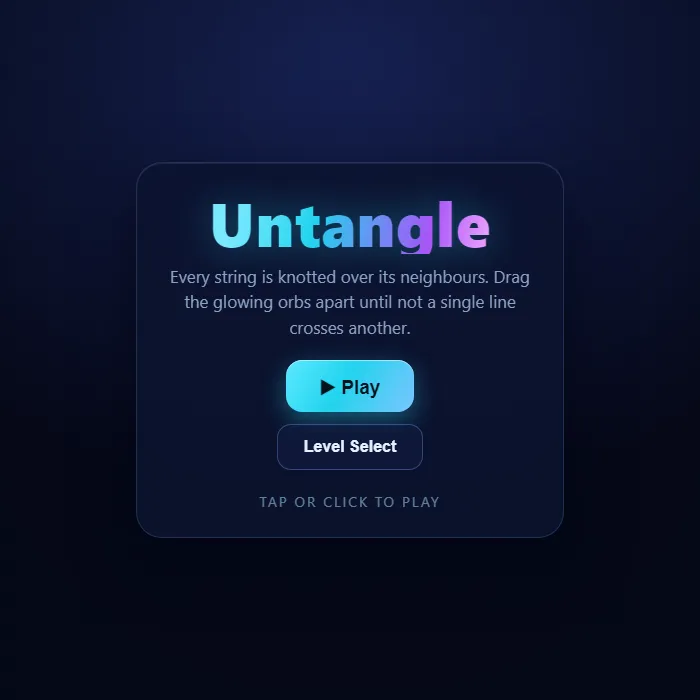
A web of glowing strings is knotted over itself. Drag the orbs apart, watch the red crossings drain to zero, and leave behind one clean, untangled constellation.
About Untangle
Untangle hands you a snarl of neon strings on a deep-space board and one simple demand: no line may cross another. Every red segment is tangled with something; drag an orb and the strings follow it live, flicking from red to cyan the instant they come clear. The crossing counter in the corner ticks down as you work, so you always know exactly how much knot is left.
The early boards come apart in a few tugs. Later ones pack nearly fifty orbs into a lattice where fixing one crossing quietly creates two more on the far side. That is where the real game lives: you stop dragging on instinct, spot the outer ring hiding inside the mess, and peel the graph open from the edges instead of yanking at its middle. Pulling one stubborn orb across the board and watching thirty crossings collapse at once is the moment that keeps you loading the next knot.
All sixty puzzles are guaranteed solvable, your best time per level is saved, and undo forgives any tug you regret. Good for a two-minute breather or a long, stubborn evening.
Where Untangle comes from
This puzzle is Planarity, written in Flash by John Tantalo at Case Western Reserve University in 2005 from a concept by Mary Radcliffe of Western Michigan University. Every level is a planar graph drawn with its vertices on a circle so that the edges cross, and a theorem by Istvan Fary guarantees such a graph can always be redrawn with straight edges and no crossings, so every puzzle is solvable. The game's viral spread earned Tantalo a place among Cleveland's 'most interesting people' of 2006; this version is 360 PlayZone's own take on the classic. Source.
Unblocked Chromebook No Download Mobile For Kids Brain Games
How to play Untangle
Grab any orb and drag it somewhere new; the strings attached to it move with you. Edges that cross another edge glow red, clean ones glow cyan, and the counter shows how many crossings remain. Rearrange the orbs until the counter hits zero to clear the level and unlock the next. Finish quickly to earn three stars for that knot.
Controls
Desktop: drag orbs with the mouse, Z undoes, R resets, M mutes, Esc opens level select. Touch: drag orbs with a finger and use the on-screen buttons for undo, reset, levels, and sound.
Tips & tricks
- Start from the rim: park the obviously-outer orbs in a wide circle first, then untangle the middle inside that frame.
- Orbs with only two strings are cheap to relocate; sling them far out of the way and deal with them last.
- If a knot will not loosen, one orb usually belongs on the opposite side of the board entirely; carry it across and see what falls clean.
- Stretching helps: spreading everything toward the edges makes the remaining crossings easy to read before you commit to fixes.
Game features
- 100% free to play — no payment, ever
- Plays instantly in your browser — no download or install
- Works on desktop, phone and tablet
- No sign-up and no email required
- Built with HTML5 — runs on any modern browser
- Single-player — play at your own pace
Frequently asked questions
How do you play Untangle?
Grab any orb and drag it somewhere new; the strings attached to it move with you. Edges that cross another edge glow red, clean ones glow cyan, and the counter shows how many crossings remain. Rearrange the orbs until the counter hits zero to clear the level and unlock the next. Finish quickly to earn three stars for that knot.
What are the controls for Untangle?
Desktop: drag orbs with the mouse, Z undoes, R resets, M mutes, Esc opens level select. Touch: drag orbs with a finger and use the on-screen buttons for undo, reset, levels, and sound.
How do you get better at Untangle?
Start from the rim: park the obviously-outer orbs in a wide circle first, then untangle the middle inside that frame. Orbs with only two strings are cheap to relocate; sling them far out of the way and deal with them last. The full tips list on this page covers the rest.
Is Untangle unblocked at school or work?
Untangle is a plain web page — no plugin, no installer, no app store — so it loads on a Chromebook or a locked-down school or office laptop the same way any other page does. Whether it opens comes down to your network's filter rather than the game itself, and there is nothing to install either way.
What kind of game is Untangle?
Untangle is a free puzzle game that runs in the browser. A web of glowing strings is knotted over itself. A typical session runs about 5–20 minutes.
Embed Untangle
Want Untangle on your own site, blog or classroom page? It's free to embed — copy this code, or browse every game you can embed:
More free puzzle games
Untangle is one of 87 free puzzle games on 360 PlayZone. Browse the whole Puzzle collection, try Bridge Builder next, or head back to the home page to explore every category. You might also like our games like Untangle roundup.