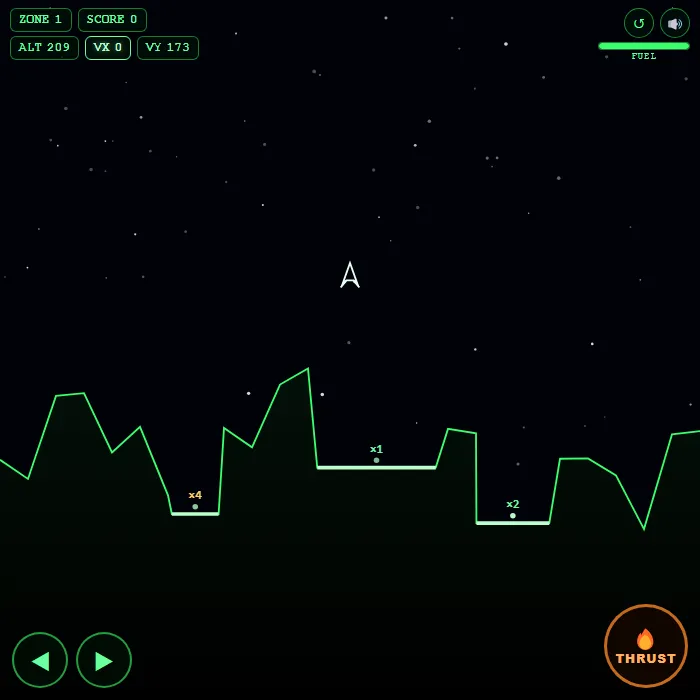
A lunar lander game online with real gravity and inertia: rotate, thrust, and burn limited fuel to touch down softly on narrow pads worth up to 5x score across 10 escalating zones.
About Lunar Lander
Lunar Lander strips flight down to the two forces that matter: gravity pulling you down, and a thruster fighting back. Rotate to aim your burn, tap the throttle to fight the fall, and watch your fuel gauge shrink with every second of thrust. The moonscape below is jagged rock except for a handful of flat pads, and the narrower the pad, the bigger the payout — a wide beginner pad might pay even money, while a sliver of flat ground barely wider than your legs can pay five times over. The tactical moment comes every descent: do you cut the throttle early to save fuel for a risky narrow pad further along, or play it safe and bank a guaranteed landing before your gauge hits empty? Crash and you simply retry the same patch of terrain with a full tank; land clean and gravity gets a little heavier, the wind gusts a little stronger, and the fuel a little stingier on the next zone. It's built for players who like precision timing and score-chasing over reflex action, and for anyone nostalgic for the vector-line arcade landers of old.
Where Lunar Lander comes from
The first Lunar Lander was a text game: in the autumn of 1969, months after Apollo 11, the high-school student Jim Storer wrote a landing simulation in the FOCAL language on Lexington High School's PDP-8, in which the player typed in how much fuel to burn each turn, and DEC's newsletter spread it to other minicomputer users. David Ahl converted it to BASIC and printed three versions in 101 BASIC Computer Games in 1973, the same year Jack Burness's Moonlander on the DEC GT40 terminal turned it into real-time graphics, and in August 1979 Atari released the arcade Lunar Lander, its first vector-graphics game, which sold 4,830 cabinets before Atari stopped production to ship Asteroids on the same hardware, the first 300 of them in Lunar Lander cabinets. This version is 360 PlayZone's own take on the classic. Source.
Inside Lunar Lander: what we checked
The numbers below come from Lunar Lander's own source code, and the screenshots are from our own test run of the game (20 October 2026).
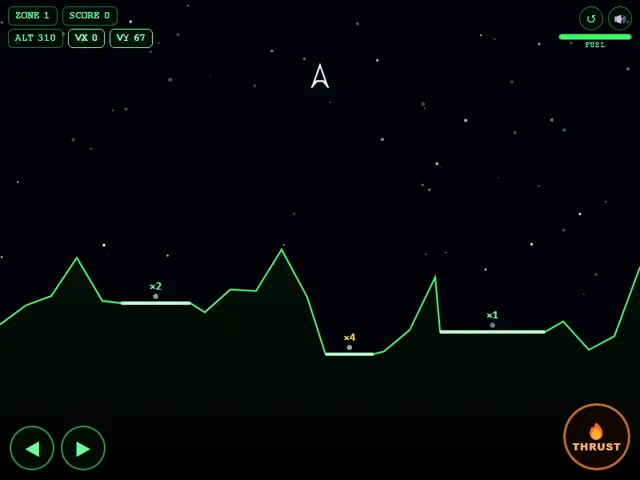
- Every zone has exactly three landing pads, each a different width. The narrower the pad, the bigger its multiplier, from x1 on the widest up to x5 on the thinnest.
- A landing scores your leftover fuel (rounded) times the pad's multiplier, with a minimum of 1 before the multiplier. Saving fuel matters more than landing fast.
- To land safely you need a horizontal speed of 50 or less, a vertical speed of 75 or less (the VX and VY readouts), and to be within about 15 degrees of upright. Touching down anywhere but a pad is a crash, however gently.
- Zone 1 gives 150 units of fuel and thrust burns 25 a second, so about six seconds of thrust. Each later zone gives 9 less, down to 69 from zone 10 onwards.
- Gravity starts at 68 and rises by 8 each zone, and sideways wind adds 5 per zone from zone 2. Both stop rising after zone 10.
- A crash restarts the zone with a full tank and keeps your score. Your best score and furthest zone are kept in this browser.
Unblocked Chromebook No Download Mobile For Kids Quick Games
How to play Lunar Lander
Rotate your ship left and right, then thrust to slow your fall and steer toward one of the flat landing pads scattered across the jagged terrain. A safe landing needs both a gentle speed and a near-upright angle when you touch down — hit a pad too fast, too tilted, or miss the pads entirely and you crash and retry the zone with a refilled tank. Land safely and your remaining fuel is multiplied by that pad's score value before you move on to a harder zone.
Controls
Desktop: Arrow keys or A/D to rotate, Up arrow, W, or Space to thrust. Touch: rotate buttons in the bottom-left corner, the THRUST button in the bottom-right.
Tips & tricks
- Watch the VX and VY readouts, not just the picture — they turn green the instant your speed is actually safe to land, which is easier to judge than eyeballing the descent.
- Cut your rotation back to level well before you reach a pad; correcting a hard tilt at the last second burns fuel fast and often overshoots into a crash.
- Narrow pads pay 3x to 5x, but they demand near-zero horizontal drift — cancel sideways speed early rather than trying to nudge onto a sliver of pad at the last moment.
- Fuel gets stingier every zone, so if you're running low, take the first wide pad you can reach safely rather than gambling on a distant multiplier.
Frequently asked questions
Does Lunar Lander save my progress?
Yes — Lunar Lander keeps your best score and settings in this browser's local storage, so they are still there when you come back on the same device. Nothing is uploaded and no account is involved — clearing your browser data is what resets it.
Is Lunar Lander unblocked at school or work?
Lunar Lander is a plain web page of about 35 KB — no plugin, no installer, no app store — so it loads on a Chromebook or a locked-down school or office laptop the same way any other page does, and the whole game arrives in one short download. Whether it opens comes down to your network's filter rather than the game itself.
Who made Lunar Lander?
Lunar Lander was built in-house by the 360 PlayZone team using open web technology (HTML5), which is why it runs instantly without any download.