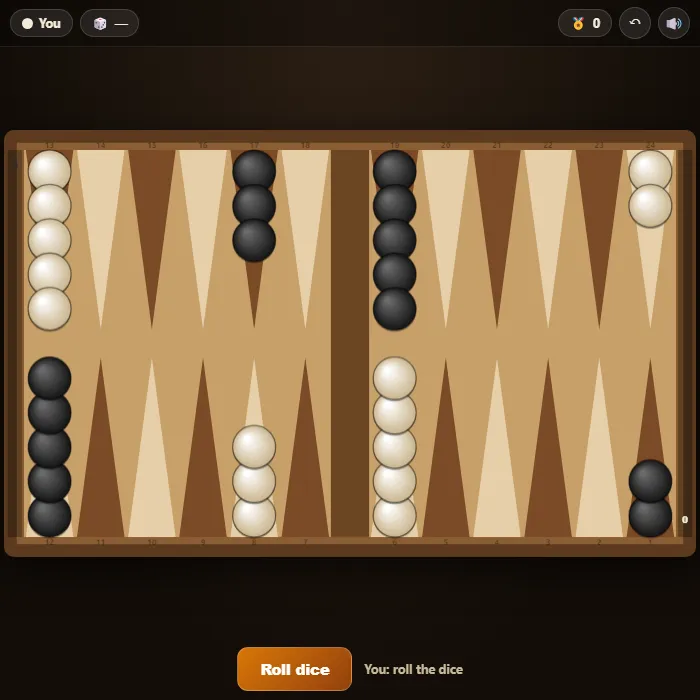
Play backgammon online free against the computer or a friend on the same device. Full rules — hitting, the bar, bearing off, gammons and backgammons — on a proper wooden board with dice you actually roll.
About Backgammon
Backgammon is the oldest game still in wide circulation, and it survives because it is a race in which luck decides the dice and skill decides everything else. You have fifteen checkers to bring all the way home and bear off, the computer is racing you the other way round the same board, and the two of you cross in the middle.
That crossing is the whole game. A single checker sitting alone on a point is a blot, and landing on it sends it all the way back to the bar to start its journey again — so every move is a small argument between making progress and staying safe. Stack two checkers on a point and you own it: nothing can land there, and a row of owned points in your home board is a wall the other side has to roll its way through. The computer plays to the same priorities, taking a hit over an advance almost every time and avoiding parking in front of your guns, so beating it means actually thinking about where your blots are.
Doubles give you four moves instead of two, bearing off needs an exact roll or a clean overshoot, and winning before your opponent has borne off a single checker scores a gammon.
Where Backgammon comes from
Backgammon is the modern member of the 'tables' family, whose ancestors include the Royal Game of Ur, played in Mesopotamia around 2600 BC, the Persian game of nard, which emerged between the 3rd and 6th century AD, and the Roman tabula. The English name first appears as 'Baggammon' in a letter of James Howell dated 1647, Edmond Hoyle codified the rules in his Short Treatise on the Game of Back-Gammon in 1743, and the doubling cube was introduced in the 1920s by members of gaming clubs on New York's Lower East Side, who had previously marked doubles with parlour matches on the bar. This version is 360 PlayZone's own take on the classic. Source.
Inside Backgammon: what we checked
The numbers below come from Backgammon's own source code, and the screenshots are from our own test run of the game (20 October 2026).
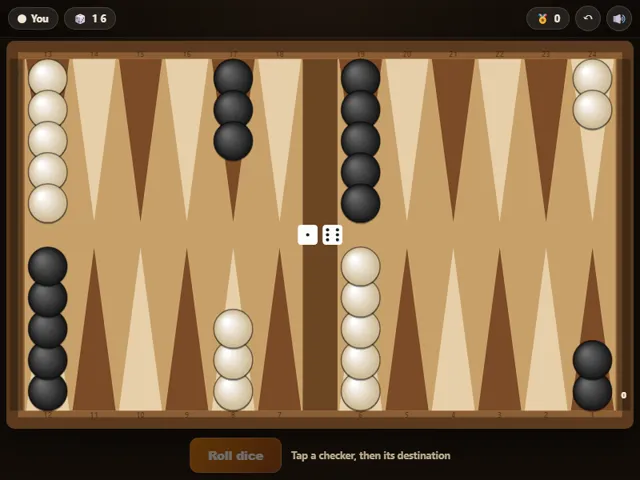
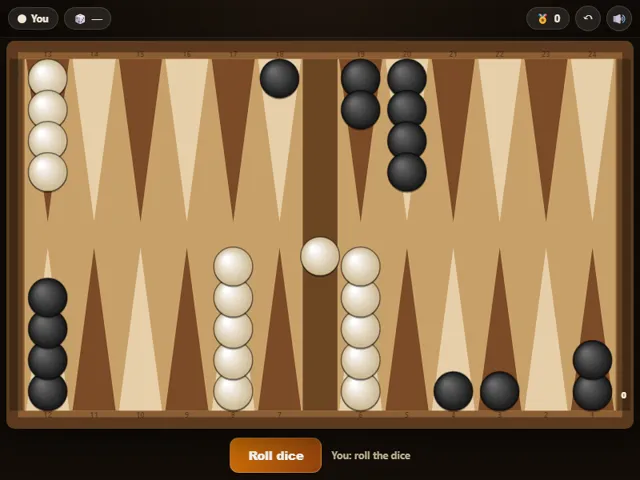
- You are always White and always move first, with an ordinary two-dice roll. A double gives four moves of that number.
- A lone checker is a blot: landing on it sends it to the bar. A checker on the bar has to re-enter into the opponent's home board before anything else can move, and the game says so if you try something else.
- Bearing off needs all 15 checkers in your home board. A die bears off the checker that exact distance from the edge, or the rearmost checker if the die is larger and nothing is further back.
- The game does not enforce the rule that you must play both dice (or the larger one) when you can. Any legal move with an unused die is allowed, and your turn ends when no die can be played.
- If the winner's opponent has borne off nothing, the end screen calls it a gammon (double stakes), and a backgammon (triple) if they also still have a checker on the bar or in the winner's home board. There is no doubling cube and no stake is kept.
- The computer scores each legal move on its own with no lookahead: bearing off, hitting a blot and re-entering from the bar all score highly, and it shuns leaving a lone checker. Undo (U) takes back moves within your own turn. Your wins against the computer are saved in this browser.
Unblocked Chromebook No Download Mobile Multiplayer
How to play Backgammon
Roll the dice, then move your checkers that many points around the board towards your home board in the bottom right. Each die is a separate move, and rolling a double gives you four moves instead of two. You can land on any point that isn't held by two or more enemy checkers; landing on a single enemy checker sends it to the bar, and a player with checkers on the bar must bring them back into play before doing anything else. Once all fifteen of your checkers are home, start bearing them off — first to bear off all fifteen wins.
Controls
Desktop: click Roll or press Space to throw the dice, click a checker to pick it up, then click the point you want it on. Green circles show every legal destination. U undoes a move within your turn, M mutes. Touch: tap the checker, then tap its destination.
Tips & tricks
- Never leave a blot inside your opponent's home board if you can help it. Getting hit there costs you the entire length of the board, which is usually the whole game.
- Making points in front of your own home board is worth more than racing. A wall of owned points is what stops an opponent re-entering from the bar at all.
- Count the pip race before you decide your plan. If you're clearly ahead, run for home and avoid all contact; if you're behind, stay back and wait for a shot at a blot.
- Bearing off needs an exact roll or nothing further from home, so spread your checkers across your home board rather than piling them all on the six point.
Frequently asked questions
Does Backgammon save my progress?
Partly. Backgammon keeps a running win/loss tally and your settings in this browser's local storage; there is no level progress to save. Nothing is uploaded and no account is involved — clearing your browser data is what resets it.
Is Backgammon unblocked at school or work?
Backgammon is a plain web page of about 22 KB — no plugin, no installer, no app store — so it loads on a Chromebook or a locked-down school or office laptop the same way any other page does, and the whole game arrives in one short download. Whether it opens comes down to your network's filter rather than the game itself.
Who made Backgammon?
Backgammon was built in-house by the 360 PlayZone team using open web technology (HTML5), which is why it runs instantly without any download.
Embed Backgammon
From our blog
Backgammon features in Ludo Online: Rules, Safe Squares, the Six-Square Danger Zone and How to Beat the CPU and Mancala Online: Kalah Rules, the Extra-Turn Opening and How to Set Up Captures.