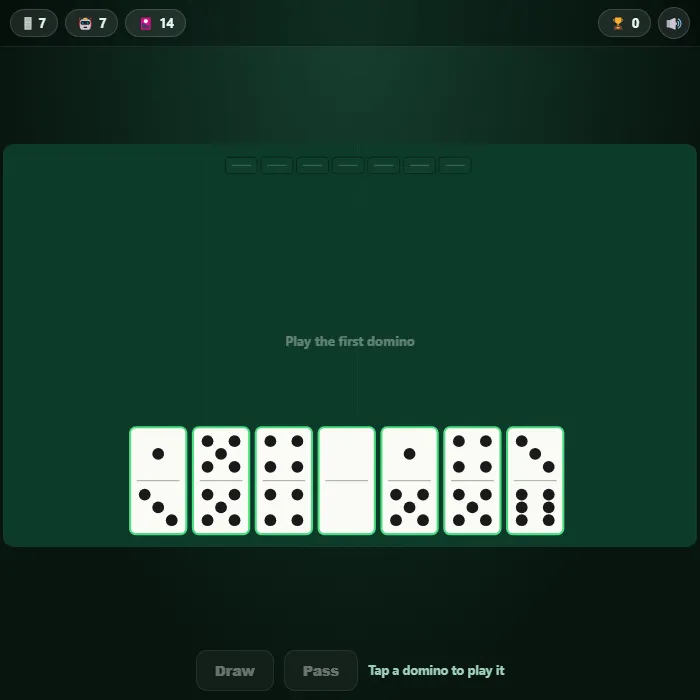
Play dominoes online free against the computer with a full double-six set. Match a number on either open end, draw from the boneyard when you're stuck, and be first to empty your hand.
About Dominoes
Dominoes is a game of information disguised as a game of luck. You each take seven tiles from a double-six set, twenty-eight in all, and take turns adding to a chain that can only grow at two open ends. Match a number, play a tile, and the ends change.
What separates a good player from a lucky one is watching what the other side can't do. Every time your opponent goes digging in the boneyard, they have told you something concrete: they hold nothing matching either open end. File that away, and two turns later you can steer both ends back to the numbers that made them draw. This is why holding a spare tile of a number you keep seeing is worth more than dumping your heaviest tile at the first opportunity — flexibility is what stops you being the one drawing.
Doubles are the awkward ones, because they only ever fit one number and they count heavily against you if the game locks up. When neither side can move, the game is blocked and the lower pip count wins, which turns a hopeless-looking hand into a survivable one if you have been shedding your sixes and fives along the way.
Where Dominoes comes from
Dominoes are first recorded in China: Zhou Mi's Former Events in Wulin, written in the late 13th century, lists 'pupai' among the goods sold by pedlars in the reign of the Song emperor Xiaozong (1162-1189), and the Chinese set of 32 tiles represents every throw of two dice with no blanks. The 28-tile double-six set played here appeared in France in the mid-18th century, the name 'domino' being first recorded in the magazine L'Avantcoureur on 1 April 1762 and probably borrowed from the black-and-white carnival costume that the double-one tile resembles; the earliest European rules describe the simple block game for two or four players, with the draw game added later in France. This version is 360 PlayZone's own take on the classic. Source.
Inside Dominoes: what we checked
The numbers below come from Dominoes's own source code, and the screenshots are from our own test run of the game (20 October 2026).
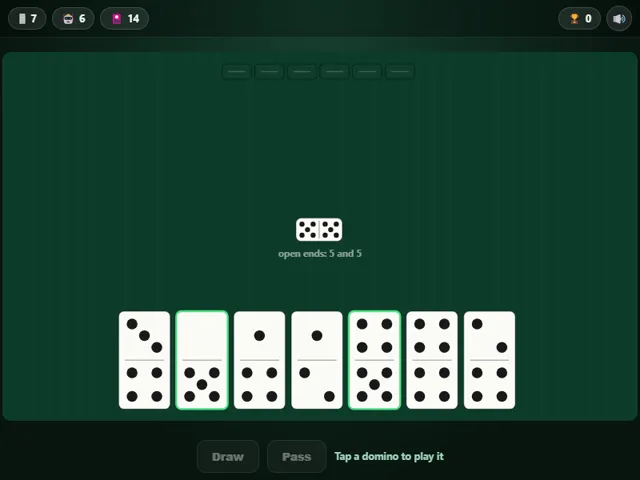
- It is a double-six set of 28 tiles. Each side is dealt 7 and the other 14 form the boneyard.
- Whoever holds the highest double goes first, and if neither side has a double the human starts. The opening play is not forced to be that double: the first player can lay any tile.
- You can only draw when you have no playable tile, and only pass when you have no playable tile and the boneyard is empty. The game stops you drawing or passing early.
- The computer plays its heaviest playable tile (pips counted, with a bonus for doubles), and draws from the boneyard until it can play. It does not plan ahead, so it will happily empty its heavy tiles first.
- If both sides pass in a row the game is blocked and the lower pip total wins. Equal totals are a dead heat.
- Your number of wins against the computer is kept in this browser.
Solitaire Unblocked Chromebook No Download Mobile Multiplayer
How to play Dominoes
Play a domino from your hand that matches one of the two open numbers at the ends of the chain. If a tile fits both ends you'll be asked which side to place it on. When nothing in your hand matches, draw from the boneyard until something does; if the boneyard is empty you pass. First player to empty their hand wins, and if the game locks up with neither side able to move, the lowest total pip count takes it.
Controls
Desktop: click a domino in your hand to play it, click the green arrow to choose an end when a tile fits both, Draw and Pass buttons below the board, M to mute. Touch: tap a domino, then tap the end you want it on.
Tips & tricks
- When the computer draws from the boneyard, note both open numbers — it has just told you it holds neither, so steering the chain back there forces it to draw again.
- Play your heavy tiles early. If the board locks up, the lowest pip total wins, and a hand still full of fives and sixes loses a game you could have survived.
- Doubles only match one number, so they are the hardest tiles to get rid of. Play them at the first legal chance rather than saving them for a better moment that may never come.
- If you hold several tiles of the same number, try to keep both ends showing it. Controlling a number you're rich in means you can always move and your opponent often can't.
Frequently asked questions
Does Dominoes save my progress?
Partly. Dominoes keeps a running win/loss tally and your settings in this browser's local storage; there is no level progress to save. Nothing is uploaded and no account is involved — clearing your browser data is what resets it.
Is Dominoes unblocked at school or work?
Dominoes is a plain web page of about 18 KB — no plugin, no installer, no app store — so it loads on a Chromebook or a locked-down school or office laptop the same way any other page does, and the whole game arrives in one short download. Whether it opens comes down to your network's filter rather than the game itself.
Who made Dominoes?
Dominoes was built in-house by the 360 PlayZone team using open web technology (HTML5), which is why it runs instantly without any download.