Minesweeper
- Is Minesweeper free?
- Yes — 100% free, no payment.
- Download needed?
- No — it plays in your browser.
- Works on mobile?
- Yes — phones & tablets, full touch.
- Session length?
- About 5–20 minutes.
- Players?
- Single player.
A logic classic that never gets old. Clear the whole grid without setting off a single hidden mine, and the numbers are all you've got to go on.
About Minesweeper
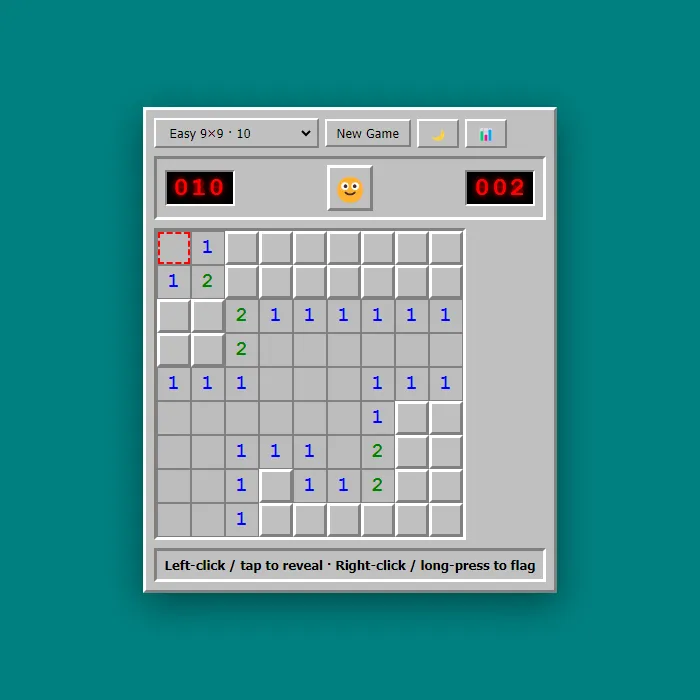
Minesweeper is a game of nerve and deduction dressed up as a grid of grey squares. You click one open, then another, watching for the numbers that turn everything into a puzzle: a 1 means exactly one mine hides among the touching squares, a 3 means three, and from those little clues you reason your way across the whole board. There's no luck in the middle of a good game, only logic you haven't worked out yet.
The satisfying part is the chain reaction. Crack one corner open and a wide safe area cascades outward, and suddenly you can see the shape of the trouble ahead. Then comes the tense bit: two squares, one number, and a fifty-fifty you'd rather not gamble on. You plant a flag on the mine you're sure of, and the board reads a little cleaner. One misclick, though, and the whole thing detonates.
It's for anyone who likes thinking under a bit of pressure, whether that's a two-minute break or a stubborn grudge match against a single stubborn square.
Where Minesweeper comes from
The Minesweeper most people know was written by Curt Johnson, originally for IBM's OS/2, and ported to Windows by Robert Donner; it shipped in the Microsoft Entertainment Pack in 1990 and was bundled with every Windows from 3.1 in 1992 to Windows 7. Johnson has said the design was borrowed from an earlier game, and Ian Andrew's Mined-Out for the ZX Spectrum (1983) is the best-known predecessor. In 2000 Richard Kaye proved that deciding whether a Minesweeper board is consistent is NP-complete; this version is 360 PlayZone's own take on the classic. Source.
Unblocked Games Unblocked Chromebook No Download Mobile For Kids Brain Games
How to play Minesweeper
Click to reveal a square at a time. The number on a square tells you how many mines are touching it, and that's the thread you pull to work out which neighbours are safe and which will blow up in your face. Flag the ones you're certain about. Clear every safe square and you've won. Click wrong once, though, and it's over.
Controls
Left-click to reveal a square, right-click to plant or remove a flag.
Tips & tricks
- Start in the open middle to reveal a big safe area.
- A number touching exactly that many hidden squares means they're all mines.
- Flag the mines you're certain of to keep the board readable.
Game features
- 100% free to play — no payment, ever
- Plays instantly in your browser — no download or install
- Works on desktop, phone and tablet
- No sign-up and no email required
- Built with HTML5 — runs on any modern browser
- Single-player — play at your own pace
Frequently asked questions
How do you play Minesweeper?
Click to reveal a square at a time. The number on a square tells you how many mines are touching it, and that's the thread you pull to work out which neighbours are safe and which will blow up in your face. Flag the ones you're certain about. Clear every safe square and you've won. Click wrong once, though, and it's over.
What are the controls for Minesweeper?
Left-click to reveal a square, right-click to plant or remove a flag.
How do you get better at Minesweeper?
Start in the open middle to reveal a big safe area. A number touching exactly that many hidden squares means they're all mines. The full tips list on this page covers the rest.
Is Minesweeper unblocked at school or work?
Minesweeper is a plain web page — no plugin, no installer, no app store — so it loads on a Chromebook or a locked-down school or office laptop the same way any other page does. Whether it opens comes down to your network's filter rather than the game itself, and there is nothing to install either way.
What kind of game is Minesweeper?
Minesweeper is a free puzzle game that runs in the browser. A logic classic that never gets old. A typical session runs about 5–20 minutes.
Embed Minesweeper
Want Minesweeper on your own site, blog or classroom page? It's free to embed — copy this code, or browse every game you can embed:
From our blog
Minesweeper features in Minesweeper Online: Rules, Number Patterns and How to Stop Losing to Luck and 20 Games to Play When Bored in Class (Free, No Download) — worth a read if you want the deeper story behind the game.
More free puzzle games
Minesweeper is one of 87 free puzzle games on 360 PlayZone. Browse the whole Puzzle collection, try Bridge Builder next, or head back to the home page to explore every category. You might also like our games like Minesweeper roundup.